Greece
Aegean
The Aegean is Greece's only native domestic cat breed — a naturally evolved bicolor cat from the Cycladic islands, shaped by three thousand years of life alongside Greek fishermen, carrying a bicolor coat in any color, a moderate and healthy physique, and a practical, sociable intelligence.
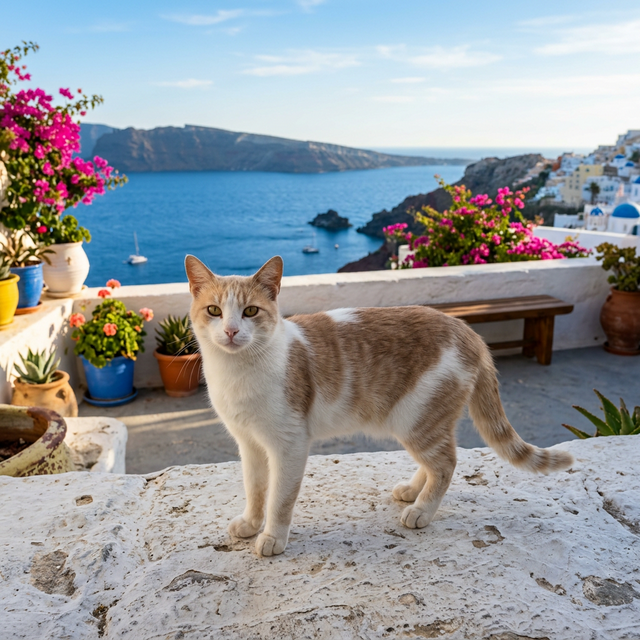
Greece gave the world philosophy, democracy, and the architectural principles that shaped Western civilization. It also, quietly and without fanfare, developed one of the world’s most ancient naturally occurring domestic cat populations — the cats of the Cycladic islands, living for three thousand years alongside Greek fishermen and island communities, adapting to the rhythms of island life, the Mediterranean climate, and the practical requirements of a working cat existence. These island cats, collectively and formally recognized as the Aegean, are Greece’s only native cat breed, and they carry in their genetic makeup the history of their island origins. They are not a created breed. They are what three millennia of island life produces when cats are left largely to their own devices in a warm Mediterranean environment: moderate, healthy, intelligent, sociable, and useful.
1. History and Origins: Cycladic Island Life
The Aegean’s history is the history of the Greek islands, stretching back in continuous genetic tradition for at least three thousand years.
The Cyclades Foundation
The Cyclades — the group of islands at the center of the Aegean Sea, including Mykonos, Santorini, Naxos, and dozens of smaller islands — have supported domestic cat populations since at least the Bronze Age. Cats arrived on these islands through the same process by which they spread across the ancient world: as working animals on trading ships and in port settlements, controlling rodents in granaries and on boats. The island environment, combined with relative geographic isolation, allowed these cat populations to develop a characteristic type over centuries.
Fishermen’s Cats
The Aegean’s most important cultural relationship was with Greek fishermen and fishing communities. The cats of the Cycladic islands lived at harbors and fish markets, scavenging the scraps of the fishing trade and providing rodent control in warehouses and boats. This relationship shaped both the Aegean’s practical adaptability — a cat that can find food in a busy harbor environment is a resourceful and flexible animal — and its ease with the noise, activity, and social complexity of human working environments.
Formal Recognition
Despite their ancient presence, the Aegean was only formally recognized as a distinct breed in the 1990s, developed by breeders at the Athens Cat Fancy Organization. Because the breeding population drew from the naturally occurring island cat population rather than from deliberate crossbreeding programs, the Aegean maintains the broad genetic base of its island origins.
The Aegean is not yet recognized by TICA or CFA but is recognized by the Greek cat fancy organization and is increasingly known internationally.
2. Appearance: The Bicolor Islander
The Aegean’s appearance is that of the Mediterranean island cat — moderate, balanced, and naturally adapted, without the extreme physical features of many pedigree breeds.
The Defining Bicolor
The Aegean’s most consistent and characteristic feature is its bicolor coat. All Aegeans are bicolor: a combination of white with any other color or pattern — black-and-white, blue-and-white, red-and-white, tortoiseshell-and-white, and so on. The white typically covers between one-third and two-thirds of the body. Solid-colored or non-white Aegeans are not considered typical of the breed.
The coat itself is medium-length, semi-long in some individuals, with no undercoat — an adaptation to the warm Mediterranean climate. It lies relatively close to the body, does not mat, and requires minimal maintenance.
Body
The body is medium-sized, moderately muscled, and well-proportioned. The Aegean is a cat of moderation — not cobby and heavy like the British Shorthair, not fine-boned and elongated like the Oriental. The legs are of medium length, the paws are medium and oval. Males weigh 9 to 11 pounds; females 7 to 9 pounds. The overall impression is of a capable, athletic, naturally proportioned animal.
Head and Eyes
The head is a moderately sized wedge with a straight profile and a well-developed muzzle. The ears are medium to large, widely set, and slightly rounded at the tips, often with interior furnishings. The eyes are almond-shaped and can be any shade of green — the most valued eye color for the breed.
3. Personality: Three Thousand Years of Practical Intelligence
The Aegean’s personality has been shaped not by breeding programs selecting for specific temperament traits, but by three thousand years of life as a working animal in active Greek communities.
Intelligent and Resourceful
The Aegean is a sharp, problem-solving cat. Its harbor and fishing community origins required practical intelligence — finding food in busy, competitive environments, navigating the unpredictable rhythms of fishing ports, coexisting with multiple humans in working settings. This background has produced a cat of cognitive flexibility and resourcefulness.
Sociable and Adaptable
The Aegean is comfortable with people and with the activity of human environments. It is not a timid or easily startled cat — it was shaped by the noise, movement, and social complexity of Greek fishing harbors, and it carries that adaptability into domestic settings. It handles new situations, new people, and changes in routine with practical equanimity.
Active and Stimulation-Seeking
The Aegean is an active cat with strong play drive and a preference for engaged, interactive living. It does not thrive in static, low-stimulation environments. It benefits from outdoor access or, where that is not possible, substantial indoor enrichment.
Independent but Connected
Like most naturally evolved working cats, the Aegean maintains a healthy independence. It does not need constant human attention to feel secure, manages its own time effectively, and maintains a self-sufficient quality that distinguishes it from more dependent breeds. At the same time, it values human company and forms real bonds with its family.
Good Hunter
The Aegean retains strong hunting instincts from its working cat heritage. It is an active, focused predator that benefits from play that engages its natural prey drive.
4. Care and Maintenance
Grooming
The semi-long coat with no undercoat is easy to maintain. Weekly brushing prevents loose hair accumulation on furniture and maintains the coat’s natural sheen. The Aegean’s coat does not mat under normal circumstances.
Exercise
The Aegean needs active daily engagement. Interactive play sessions of at least 15 to 20 minutes twice daily, combined with climbing opportunities and a rotating selection of toys, keep this intelligent and active cat satisfied. Access to a secured outdoor area or garden significantly enhances quality of life.
Social Needs
The Aegean does well with other cats and with dogs, reflecting its multi-animal harbor origins. A solo Aegean in a low-stimulation household will not thrive — it benefits from either human company during the day or the presence of another active cat.
5. Health and Lifespan
The Aegean is a robust and healthy breed, with a lifespan typically cited as 9 to 12 years — though island-dwelling Aegean cats in Greece are reported to commonly live into their mid-teens.
Genetic Diversity
Like the European Shorthair, the Aegean benefits from broad genetic diversity maintained through its natural island breeding history. No significant breed-specific hereditary conditions have been formally documented.
Climate Adaptation
The Aegean is adapted to warm Mediterranean conditions. In cold climates, supplementary warmth and indoor access during cold months is important for a breed without the undercoat insulation of northern breeds.
6. Suitability
Ideal for:
- Owners who want a naturally evolved breed with documented ancient lineage
- Active households that can provide enrichment and ideally outdoor access
- People who appreciate the bicolor Mediterranean aesthetic
- Those interested in rare, less commercially developed breeds
Less ideal for:
- Cold climates without supplementary heating
- Those wanting a sedate, low-energy companion
- People seeking a breed with formal international championship recognition
Conclusion
The Aegean is the cat you see winding between the blue-painted chairs of a Mykonos taverna at dusk, accepting an offered piece of fish with dignified gratitude and then returning to its survey of the harbor below. It is among the oldest continuously existing domestic cat populations in the world, shaped by islands and sea and fishing boats and three thousand years of coexistence with Mediterranean civilization. It carries that history lightly — in its bicolor coat, in its practical intelligence, in its ease with human activity and its dignified adaptability. For the person who wants a cat with ancient roots rather than a human-constructed pedigree, the Aegean offers something rare: a breed that made itself.
Key Characteristics
- Life Span
- 9 - 12 years
- Temperament
- Intelligent, Active, Sociable, Adaptable, Independent