United States
American Curl
The American Curl is a uniquely beautiful cat defined by its distinctively backward-curling ears — a natural mutation that gives it a permanently alert, open expression and has captivated cat lovers worldwide since its accidental discovery in 1981.
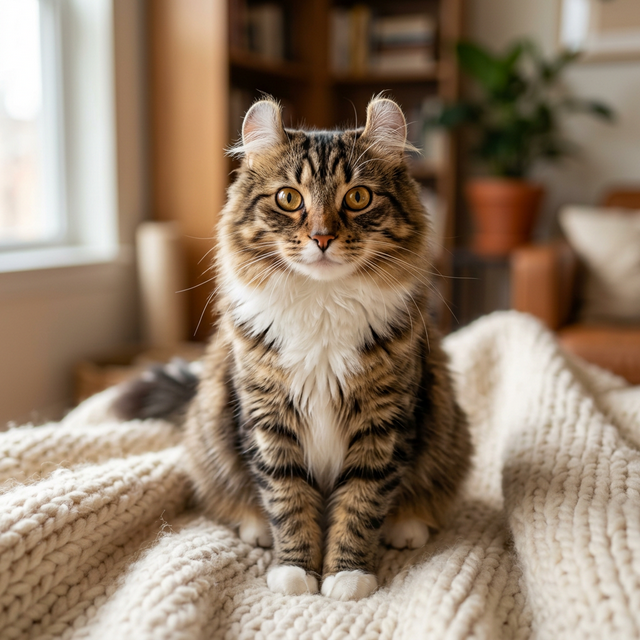
The American Curl is a cat where the first thing you notice is the ears — and then you cannot stop noticing the ears. They curve backward, away from the face, like a pair of small wings or the scrolled ends of a violin. The cat looks permanently curious, permanently attentive, permanently delighted. Beyond its signature feature, the personality lives up to the expression. This is a warm, curious, adaptable cat that retains a kitten-like playfulness throughout its life, earning it the nickname “the Peter Pan of cats.”
1. History and Origins: A Stray in Lakewood
The American Curl’s story begins with an unexpected encounter and a perceptive observer.
Shulamith
In June 1981, a stray black longhaired female kitten with distinctive backward-curling ears appeared at the doorstep of Joe and Grace Ruga in Lakewood, California. The Rugas named her Shulamith and took her in. When Shulamith produced her first litter, approximately half the kittens had the same curled ears — confirming that the mutation was dominant and heritable.
Recognition of the Potential
Cat fancier Nancy Kiester saw kittens from Shulamith’s line and recognized that this was something novel. She brought the cats to the attention of the cat fancy world, and the first American Curl was exhibited at a cat show in 1983, where it attracted significant attention and interest.
Rapid Recognition
The American Curl achieved championship status with TICA in 1987 and with the CFA in 1993 — a fast track to full recognition for a newly discovered breed, spanning only six and twelve years respectively from first exhibition. Both shorthair and longhair varieties were recognized. Today the breed is found in cat fancies worldwide.
The Gene
The ear curl is caused by a dominant genetic mutation. A single copy of the gene is sufficient to produce curled ears. Unlike the Manx tail gene or the Scottish Fold ear gene, the American Curl gene does not cause any known skeletal or cartilage health problems when homozygous (two copies). This is a key reason the breed has been accepted without the health concerns that surround some other structural mutations.
2. Appearance: The Sculpted Ear
The American Curl’s appearance is elegant and well-proportioned, with the curled ears as a dramatic focal point rather than a distortion.
The Ears
The ears are the defining characteristic. They curl backward in a smooth arc, with the tips pointing toward the center of the back of the skull. The degree of curl is measured in degrees and classified into three grades:
- First degree: Slight curl, 0–90 degrees. These cats are not shown but are registered.
- Second degree: Moderate curl, 90–135 degrees. Accepted in shows.
- Third degree: Full curl, 135–180 degrees. The ideal for show purposes — the ear curves in a smooth arc like a crescent moon, with the tip pointing directly toward the base of the ear on the back of the skull.
The ears must be handled very carefully. They are firm rather than soft at the base — the cartilage is more rigid than in a normal cat’s ear — and bending them forcibly can cause damage. They should never be bent backward beyond their natural position.
Kittens
American Curl kittens are born with straight ears. The curl begins to develop at three to five days of age, gradually increasing and then stabilizing by around four months. This slow development is part of the breed’s appeal — watching the ears curl over the first weeks of life.
Body and Coat
The American Curl is a medium-sized cat with a semi-foreign body type — neither compact nor elongated, but balanced and athletic. Males weigh between 7 and 10 pounds; females between 5 and 8 pounds.
The coat comes in both shorthair and longhair varieties. The longhaired version has a flowing silky coat with minimal undercoat, which means it is less prone to matting than heavier longhaired breeds. The shorthaired version has a soft, close-lying coat. Both varieties come in every possible color and pattern.
Face
The head is a modified wedge — slightly longer than wide — with a rounded muzzle and large walnut-shaped eyes that add to the breed’s open, alert expression.
3. Personality: The Peter Pan Cat
The American Curl’s personality is affectionate without being suffocating, playful without being destructive, and adaptable without being indifferent.
Kitten Energy for Life
The American Curl retains a kitten-like playfulness well into old age. Senior American Curls still engage enthusiastically with toys, chase moving objects, and initiate play with their owners. This enduring energy makes them a lively, entertaining companion at every life stage.
Affectionate
American Curls form warm, lasting bonds with their families. They enjoy physical contact, will seek out laps, and will often sleep pressed against their owners at night. However, their affection has a lightness to it — they are not clingy or demanding, and they respect personal space when you need it.
Curious and Interactive
These cats are curious about everything. New objects, bags, boxes, and visitors are all investigated with enthusiasm. They enjoy being involved in household activities and will supervise from a nearby perch if they cannot participate directly.
Gentle with Children
The American Curl’s gentle, patient nature makes it a good choice for families with children. It is tolerant of handling and play, and its sturdy build means it is not easily injured by exuberant young hands. However, as with any cat, children should be taught that the ears must never be bent or manipulated.
Adaptable
The American Curl adjusts to new environments, new people, and new household dynamics more readily than many breeds. This makes it a good candidate for households with multiple pets or frequently changing circumstances.
4. Care and Maintenance
Ear Care
The ears require specific attention. Because the ear canal angle is slightly altered by the curl, wax and debris can accumulate more easily. Check the ears weekly and clean gently with a veterinarian-approved ear cleaner if wax buildup is visible. Never attempt to straighten the ears or bend them in any direction. The cartilage, while stronger than normal, can be damaged by forced manipulation.
Grooming
The shorthaired American Curl needs very little grooming — a weekly wipe-down with a grooming mitt is usually sufficient. The longhaired variety benefits from two to three brushing sessions per week with a soft slicker brush or a wide-tooth comb, paying attention to the areas behind the ears and under the arms where tangles are most likely to form.
Exercise and Enrichment
Daily interactive play is important. The American Curl’s curiosity and playfulness mean it benefits from environmental enrichment — cat trees, puzzle feeders, window perches, and interactive toys. It is not a breed that entertains itself passively.
5. Health and Lifespan
The American Curl is a healthy breed with a lifespan of 12 to 16 years. Unlike some breeds defined by structural mutations, the American Curl ear gene has not been associated with health complications.
Ear Infections
The altered ear canal geometry means American Curls can be more prone to ear infections and wax buildup than straight-eared cats. Regular ear checks and careful cleaning significantly reduce this risk.
Hypertrophic Cardiomyopathy (HCM)
As with most cat breeds, HCM is a potential concern in older individuals. Routine veterinary cardiac screenings are recommended.
Spinal Stiffness
Some older American Curls may develop stiffness in the lower spine, thought to be related to the same cartilage-influencing gene responsible for the ear curl. This is generally mild and manageable with appropriate veterinary care.
6. Suitability
Ideal for:
- People drawn to unique physical features in a cat
- Families with children who need a patient, playful cat
- Owners who want a long-lived, adaptable companion
- Multi-pet households — the breed adapts well to other animals
Less ideal for:
- Households with young children who may try to manipulate the ears
- Those who want a very quiet, sedentary cat
- People unwilling to perform regular ear checks and gentle cleaning
Conclusion
The American Curl earns its reputation on every count. The ears are a structural feature so graceful that they look designed rather than accidental. The personality is warm, curious, and enduringly youthful. The health profile is reassuring. And the adaptability means that almost any household, with almost any configuration of people and pets, can become a home where an American Curl thrives. Shulamith, the foundling stray of Lakewood, California, left quite a legacy.
Key Characteristics
- Life Span
- 12 - 16 years
- Temperament
- Affectionate, Curious, Playful, Gentle, Adaptable